
AlphaWorld was launched on June 28th 1995 by Worlds, Inc.1 as standalone virtual world software. It was arguably the first extensive, multi-user, 3D virtual world.
During 1997, AlphaWorld was renamed ActiveWorlds (at activeworlds.com). At this point, AlphaWorld now referred to one of hundreds of different worlds within ActiveWorlds. ActiveWorlds eventually allowed users to purchase their own access to the proprietary ActiveWorlds server software to host their own “universe”, separate from ActiveWorlds. Someone ended up purchasing this license, who eventually named their own server DeltaWorlds. The DeltaWorlds admin crucially included a preservation of AlphaWorld circa 1995-2019 within DeltaWorlds.
ActiveWorlds/DeltaWorlds split
By including duplicate content from ActiveWorlds, DeltaWorlds essentially established a hostile split, or “fork” from ActiveWorlds. Although, through preservation projects, they could also be seen as “more original”.
While DeltaWorlds focused on preserving 1990s content, the client is still occasionally updated. The client for DeltaWorlds is mostly an old ActiveWorlds client from 2015, with minor modifications made in 2024 by the DeltaWorlds team.2

Why users migrated to DeltaWorlds
DeltaWorlds policy and software serve to resolve numerous complaints about how ActiveWorlds has been managed over time.
A primary reason that a portion of users migrated from ActiveWorlds to DeltaWorlds is that, unlike ActiveWorlds, DeltaWorlds doesn’t require money for any participation. The introduction of pay-to-play features on ActiveWorlds is a widespread and consistent complaint online. Using the brand name ActiveWorlds, it costs money to build and become a citizen, for example.
Other potential reasons for migration have been published. The ActiveWorlds historian “Eep²” also accuses ActiveWorlds of arbitrary bans/locks.3 The DeltaWorlds owner separately accuses the ActiveWorlds maintainers of prior webcam/mic manipulation and other abuses.4 However, given the latter two allegations are according to a semi-competitor, she could also have self-interested reasons to publicize these claims. These claims involve legacy builds beyond the scope for historical confirmation, and so this article cannot take a side on them, but the complaints about modern ActiveWorlds management are diverse. ActiveWorlds also does not have moderation control of the most popular ActiveWorlds forum on Reddit, possibly further coloring sentiment against ActiveWorlds.
Modern DeltaWorlds
DeltaWorlds now offers a way to participate in dozens of separate online virtual worlds. Understanding DeltaWorlds requires recognizing it’s not a game. To gain a bird’s-eye view and position DeltaWorlds among similar virtual world collections, a few regularly misused acronyms must be rejected. This includes acronyms like MMORPG, CVE, and MUVE, which either have ‘game’ in the acronym or do not explicitly exclude game mechanics. DeltaWorlds is instead a collection of User-Created, General Purpose Virtual Worlds (or UCGPVW for short). This includes DeltaWorlds’ still largest world, “AlphaWorld”. “General Purpose” means the worlds have no inherent game mechanism by default.
The purpose of participating in DeltaWorlds is simply social interaction and world building, allowing the users to build whatever they want to live and interact in. Outside of a very small number of MMORPG style worlds, there is no explicit objective to participating in a particular virtual world within DeltaWorlds. Users assign their own meaning to participating in most of the virtual worlds, and are only bound socially to treating each other with basic courtesy. There are no default enemies or monsters, no quests in most worlds.
AlphaWorld
To get a sense of what AlphaWorld in DeltaWorlds looks like during usage, below is one of my earliest explorations of DeltaWorlds. The avatar in the video walks along a modern reconstruction of 1995 AlphaWorld’s ‘Alpha Street’.
Blind video exploration
The land of permanently abandoned property
The video clearly shows buildings are empty and abandoned, but doesn’t explain why. In DeltaWorlds, once a plot of land is claimed by building (anything) on it, it is forever that person’s land. The lack of sharing land for future users gives AlphaWorld its overall dilapidated urban feel. Users can’t restructure long-abandoned property with any ease. The only solution is to contact the admin for all of DeltaWorlds, and hope they help out with repairs. Unfortunately, there are too few staff to manually fix the thousands of previously hotlinked broken images and wav files. Also, unlike DeltaWorlds, ActiveWorlds has entirely disabled loading assets from external servers.
Thousands of buildings aren’t just abandoned. The totally lost, previously hotlinked images inside them make them difficult to figure out. As explained in the video, a large percentage of buildings are also solely dedicated to simply housing these broken images, effectively making the entire buildings beyond repair. Each broken image is replaced with a placeholder image of TV static.
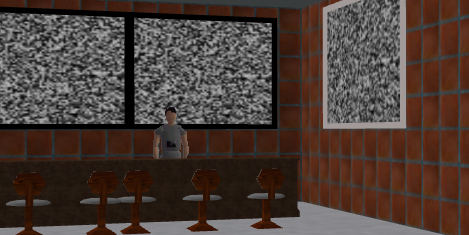
Despite the dilapidated feel, there is a navigation structure so non-linear that it can create a sense of mystery and personal achievement through discovering impressive architecture by chance.
User navigation
Like most UCGPVWs with an established world center, areas outside the center of AlphaWorld become less organized the farther you venture out. Unless you have been informed by someone of a coordinate within the world, navigation primarily involves stumbling randomly across scattered “warps”, or door-shaped vertical planes on pillars you can walk through which transport you to the area labeled on a sign above the door-shaped plane.
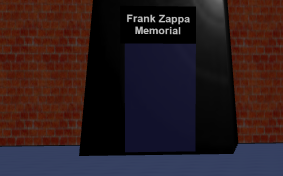
As these warps are placed haphazardly throughout AlphaWorld, navigation through the world is unpredictable. From a user perspective, you find yourself arriving at “islands” of cityscape, defined by seemingly infinite land surrounding rather than water. These land buffers are most often too large to walk between, rendering you stranded in any particular “island”, unless you teleport out through a warp, use a reserved coordinate, or simply restart your journey at spawn.
And there is plenty to explore within a lifetime. The world is vast. Brent Ryan wrote in the Journal of Urban Design that it would take 40 hours1 of walking just to traverse a linear path from the center of AlphaWorld to the closest edge of the world using your virtual avatar. This path can be measured in “cells”.
AlphaWorld’s grid, which serves as its building “floor”, is a square “flat world” divided evenly into geographical squares called “cells”. Each cell is meant to be the equivalent of 10 meters in meatspace5 (the “real-world”). There are 32,750 cells in each cardinal direction of the grid1 for a total of 4,290,250,000 cells to build on in AlphaWorld. So to contextualize how long it would take to explore the entirety of AlphaWorld, a 40 hour straight-line journey from the center to the edge would involve traversing only 32,750 cells, a microscopic fraction of the world.
The software was not designed with the intention of users venturing and building outside the grid’s edges, but hacks have been found to build outside this grid regardless.6 Users can also traverse and build beneath (underground) this grid floor.
To compensate for slow walking speed on the grid, the software also allows you to fly far above the grid and traverse at greater speeds than walking. Users can also teleport directly to a coordinate of their choice instantly.
Apart from the dilapidated feel, citizens who have used other user-created 3D virtual worlds may be surprised by AlphaWorld’s visual consistency.
Primitive graphics homogeneity
AlphaWorld’s primitive visual homogeneity is partially caused by a dated client and 3D renderer.
Extreme differences in 3D object complexity make other virtual worlds like Second Life visually headache-inducing. In one area of Second Life you may see an avatar with thousands of triangles standing next to a building made of a few simple planes. This looks somehow more unnatural and jarring than a sea of more uniformly primitive 1990s 3D graphics. User-created complex 3D objects can too often lead to poorly aligned vertices, graphics that feel too “busy”, and poor software performance.
Beyond the primitive 3D engine used, the relative uniformity of AlphaWorld is partially enforced by administrator discretion. Only the administrator of a particular world can upload 3D objects to that world, including AlphaWorld.
Once approved by an administrator, uploaded objects are placed within AlphaWorld via virtual lots called ‘object yards’. Citizens walk around object yards by walking past rows of building blocks for potential creations: doors, ceilings, or any other object they may want to use.
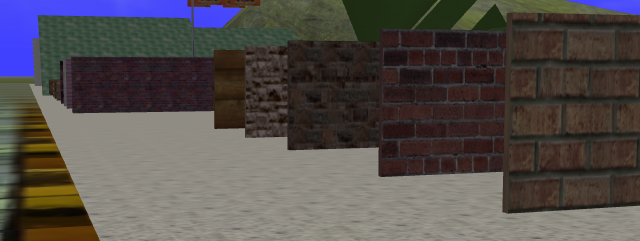
AlphaWorld clients are primitive in features as well. There is no 3D asset storage system for users! If a citizen intends to use an object they like in the object yard, but are distant from where they are building, they often must save the object name outside the program. This is often done with Microsoft Notepad, according to citizens I spoke to.
If AlphaWorld retains uniformly primitive 3D objects, the resulting render efficiency and visual harmony can remain an attractive pull.
Incentive structure
With property permanency and land scarcity, AlphaWorld users are incentivized to claim as much land as possible using attractive and memorable coordinate axes. People have used bots to claim thousands of lands that otherwise wouldn’t be claimed just for vast ownership rights.
Historical incentives of claiming virtual land
Because any sequence of computer bytes can be easily and infinitely replicated elsewhere for free, taking pride in ownership of virtual land seems absurd at first. But that hasn’t stopped people from assigning real-world value structures on ephemeral digital property consistently across decades.
Early online virtual billboards were similar to the land scarcity incentive in AlphaWorld. With early virtual billboards, you would claim a limited number of pixels within the billboard, and then they were yours forever in a finite grid of pixels. Early bulletin board pixel claimers and virtual world inhabitants both see value in claiming ephemeral digital space through the associated thrill, novelty, popularity of the associated virtual brand, and product advertising potential. AlphaWorld itself has plenty of land devoted entirely to product ads within it.
An example of a memorable product advertisement in AlphaWorld is a 27+ year old Greek Temple made by Kate Wachs, Ph.D., at coordinates ‘AW 3068N 70E’. Hoping to generate business, Wachs linked her 3D temple to an HTTP site claiming it was the first and only full-service, virtual “relationship center”.7 On this site she offered aggressive matchmaking services via real-world, print classifieds.
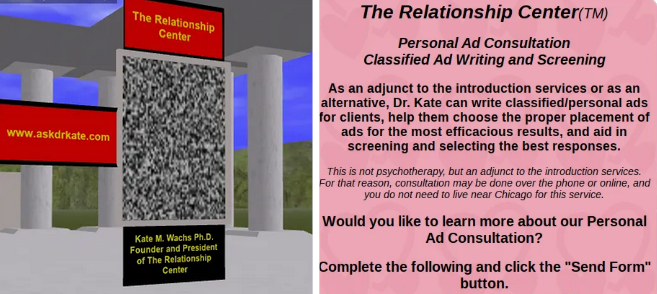
Her business is now defunct, and unfortunately, she died 7 years ago.8 Being a 31-year-old virtual world, AlphaWorld is now home to a non-negligible amount of virtual obituaries and textual well-wishes to citizens who are actually deceased outside of the virtual world.
Pride in virtual land ownership also extends beyond novelty and advertising value. An oft-repeated mantra in virtual worlds is that the community of real-world individuals assigns the true value to any particular virtual world. And the real-world people attached to virtual property can’t be infinitely replicated like the mere structure of virtual worlds theoretically can be. If a group of individuals can’t connect well, socially, with each other in particular world, they are free to create a new world in DeltaWorlds.
Other worlds in DeltaWorlds
As of 2026, there are 76 other “worlds” in DeltaWorlds separate from AlphaWorld, often to accommodate the fact that AlphaWorld is English dominated. For example, ‘V3DHistoire’ is a fairly large French-language world in DeltaWorlds that consists of many individual residences along a city structure.
In theory, because the software lets anyone create a world, users have the ability to craft highly personalized experiences. There are a few small worlds like this that are only about the size of a single building and showcase the builder’s unique artistic vision. Given the DeltaWorlds client is primarily based off a 2015 ActiveWorlds client, newer worlds take advantage of what may have been incrementally CPU-expensive updates since the AlphaWorld of the 1990s, but the difference is not extreme.
DeltaWorlds citizenship formation
ActiveWorlds and DeltaWorlds are both still available for download as of 2026.
Getting started in DeltaWorlds is non-obvious. The process involves manually adding the owner “Xan” as a contact within the client and “telegramming” her for building rights.
Within DeltaWorlds, users are spawned in AlphaWorld by default. The spawn location is deliberately chosen off-center to showcase 1995 AlphaWorld reconstruction efforts by the administrators. Specifically, the road at spawn is a historical road named Alpha Street and the surrounding buildings are presented like museum artifacts. However, by teleporting to “AW N0 E0” via the “Teleport” tab, users can travel to the historical spawn just like someone in the 1990s.
DeltaWorlds continues to provide those looking for an escape from the day-to-day. Specifically, it provides a computationally efficient way to live in the very beginnings of early 1990s virtual life alternatives.
Disclosure: As of publishing I have no close relationship with any ActiveWorlds or DeltaWorlds administrator, no personal negative history with ActiveWorlds, and no administrator/moderation rights on any platform discussed.
Ryan, B.D. (2004). “AlphaWorld: The Urban Design of a Digital City. Journal of Urban Design”. Carfax Publishing. Retrieved July 14, 2026. ↩︎ ↩︎ ↩︎
Tompkinson, X. (2024). “New Features in 6.2”. DeltaWorlds Wiki. Retrieved July 14, 2026. ↩︎
Eep² (n.d.). “Active Worlds History”. TNLC. Retrieved July 14, 2026. ↩︎
Tompkinson, X. (2025). “Reddit comment on r/ActiveWorlds”. Reddit. Retrieved July 14, 2026. ↩︎
MeatballWiki (2011). “MeatSpace”. MeatballWiki. Retrieved July 14, 2026. ↩︎
AW Times (2013). “World sizes - Cell grid”. Venice3D. Retrieved July 14, 2026. ↩︎
Wachs, K. (1999). “The Relationship Center Online”. AskDoctorKate. Retrieved July 14, 2026. ↩︎
Michael’s Funeral Home (2019). “Official Obituary for Kathleen M. Dr. Wachs”. Michael’s Funeral Home. Retrieved July 14, 2026. ↩︎